For thousands of years, humans have used the art of
persuasion in order to have others do something for them. This may be to buy a
product or service, or help them out with a favor. One of the most critical
views of how one reacts to this persuasion is through the theory of cognitive
dissonance. This psychological theory states that we act first and then
rationalize our behavior afterward in order to fit our actions into
self-perceived notions of who we are. In simple terms, this means that when we
know we are doing something we should not be doing, we try to rationalize the
reasons why we are doing these actions to make them “okay” in our minds.

Cognitive dissonance separates our thoughts from our actions.
This separation of thought and action creates unwanted
tension for humans. The best way to reduce this tension is through rationalization
of our actions. One great example of how cognitive dissonance works is in the
picture to the right. Our mind is telling us that smoking is bad and unhealthy, while
our body continues to want to smoke. After we continue smoking, our mind will
try to rationalize why we smoked because we want to close the amount of tension
that we felt. Although the nicotine already has an effect on why we continue
smoking, cognitive dissonance is another important factor in the rationalization
of this deadly habit.
Cognitive dissonance rears its head in the realm of social
psychology as well.
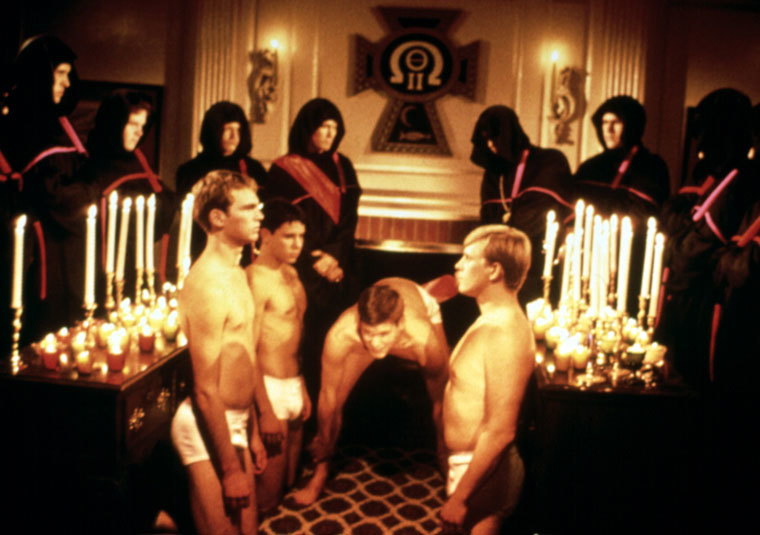 |
| This scene from Animal House is a comic look at hazing. |
This theory of persuasion also can be seen in college life,
particularly through membership in a fraternity. It is a long-standing
tradition for many fraternities (and even sororities) to haze their new members
as a form of initiation. Many people on who do not join a fraternity would ask,
“Why would someone object themselves to that type of humiliation just to be a
member of a fraternity”. For people on the outside, it is hard to understand
why a person would want to ever be a part of such a heinous system. However,
those who are a part of it use cognitive dissonance to rationalize why they are
doing what they do. When the pledges are partaking in their hazing, their minds
often question why they would ever subject themselves to this. Their actions on
the other hand continue with the humiliation thanks to cognitive dissonance. As
the hazing continues, the mind will try to rationalize its actions with
thoughts like “this hazing will not last forever, and at the end of it I will
finally be able to call myself a brother” or “everyone before me has gone
through this to join the fraternity, so I should just suck it up”. As these
thoughts go through the pledge’s head, they will begin to believe that the
hazing is not a bad thing, but a part of life in the fraternity.
Lobbyists use this trade in order to get their point across.
One
profession that uses cognitive dissonance is lobbying. The main job of a
lobbyist is to influence legislation on behalf of a special interest group.
Lobbyists use cognitive dissonance as a form of persuasion in order to get
their agenda across. One prominent idea of how this is done is in the movie ThankYou For Smoking. In the movie, Aaron Eckert plays a lobbyist who works in the
tobacco industry in order to lobby for looser regulations on cigarettes. Eckert’s
character uses persuasion in an effort to ease the cognitive dissonance that
people feel when they think of smoking cigarettes. The movie goes on to show
the vast power of the persuasion and shows how ones words can help to eliminate
the tension that occurs from cognitive dissonance.
Advertising
uses product placement to eliminate cognitive dissonance.
One of the most prominent types of advertising is product
placement. In product placement, a movie studio is paid by an advertiser to
have their product prominently seen in the movie. The hope of this
advertisement is to have viewers see their favorite actors using the product,
and in turn have them want to use the product as well. Product placement can
even help ease cognitive dissonance in a viewer. Let us continue with our
example of smoking cigarettes. Although the viewer knows that there are health
risks to smoking, he or she continues to smoke. This person may rationalize
that it is okay to smoke because in a recent movie they saw Brad Pitt was
smoking the same cigarette brand. In the mind of the user, seeing Brad Pitt
smoke the cigarette made it okay for him or her to smoke a cigarette as well.
Although this may seem morally wrong, to the advertisers it is just another way
of making money. Using cognitive dissonance to their advantage is one way that
advertisers help to promote their products. The theory of cognitive dissonance
is a powerful tool that can be used for both good and bad purposes, but it
seems as though advertisers will continue to use it as a means of selling their
goods/services.

No comments:
Post a Comment